Amano Kouya — The Last Indigo Workshop of Hirose
In the quiet town of Hirose, tucked within Yasugi City, Shimane Prefecture, stands Amano Kouya — the last surviving indigo dye house in the region. Founded in 1870, it began as a specialist workshop dedicated to dyeing threads a deep, luminous blue.
Hirose was once alive with the rhythm of looms. The town flourished as a centre for Hirose kasuri — a type of ikat weaving that used hand-dyed indigo threads, tied and resist-dyed before being woven into soft, blurred patterns. Its simple warmth and natural hues made it one of the three major kasuri production regions of western Japan, alongside Kurume kasuri and Iyo kasuri. At its peak, numerous dye houses competed in skill and beauty. But a great fire in 1915, followed by the decline of the dyeing industry after the war, brought that golden age to a quiet close.
Still, Amano Kouya endured. Under the dedication of its third-generation master, Kei Amano, the family workshop helped revive the tradition of Hirose kasuri. Today, it remains the only indigo workshop in Hirose, preserving techniques passed down for more than a century. The craft continues through the hands of the fourth-generation weaver, Toru; the fifth-generation dyer, Hisashi; and Toru’s wife, Kimie, who handles the sewing — a family united in devotion to the art of indigo.
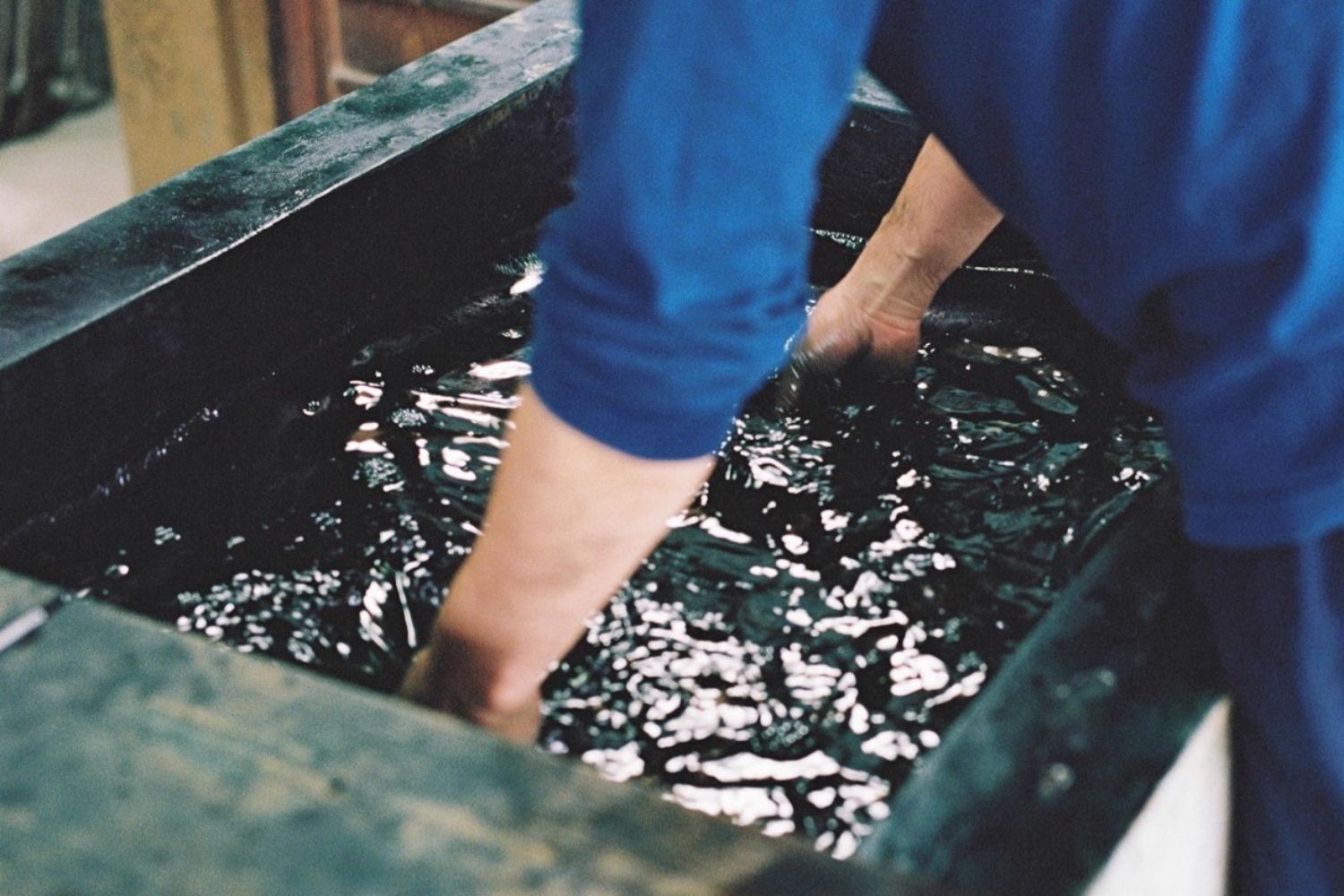
The dyeing process itself is a slow collaboration with nature. Indigo is born from fermenting the leaves of the indigo plant, creating a living dye that breathes and transforms. Threads are dipped repeatedly into the vat, then lifted into the air to oxidize — a quiet alchemy that deepens the blue with every layer. Each shade depends on the artisan’s sensitivity: the temperature, the air, even the mood of the vat.
Amano Kouya’s indigo is prepared using a traditional method known as waritate, blending a small amount of “Indigo Pure,” the same pigment used for jeans, into the natural vat. This gives their work a distinctive, luminous tone — a blue with life and depth.
The tenugui cloths available through Kinari are created using a technique called bassen, or discharge dyeing. After the fabric is dyed, an original stencil is applied to carefully lift away the color, revealing intricate designs in soft contrast.